Can knowledge outlive the grid?
A pocket-sized Raspberry Pi that runs a language model offline, for when there are no books, no mentors and no internet.
Knowledge is survival
When you have to survive with no books, no mentors and no internet, what knowledge still matters? And when memory begins to fade, when even a single human can no longer carry their own cherished past, we turn to tools and machines to remember for us.
So what fragments of civilization must the machine remember first? Is it medicine, shelter, or the memory of language itself? What is the minimum data that still carries the weight of humanity? If knowledge becomes fire, who does the machine choose to warm, and who might it burn?
Listing the components: scrap or buy
- Raspberry Pi 5 (buy)
- Raspberry Pi heatsink (buy)
- Acrylic back cover (scrap)
- Camera (scrap, from my old Logitech webcam)
- Screen (I first tried to scrap one from a Nintendo DS, but it failed)
- Power supply (scrap USB-C cable and battery, still to be improved)
Built without soldering
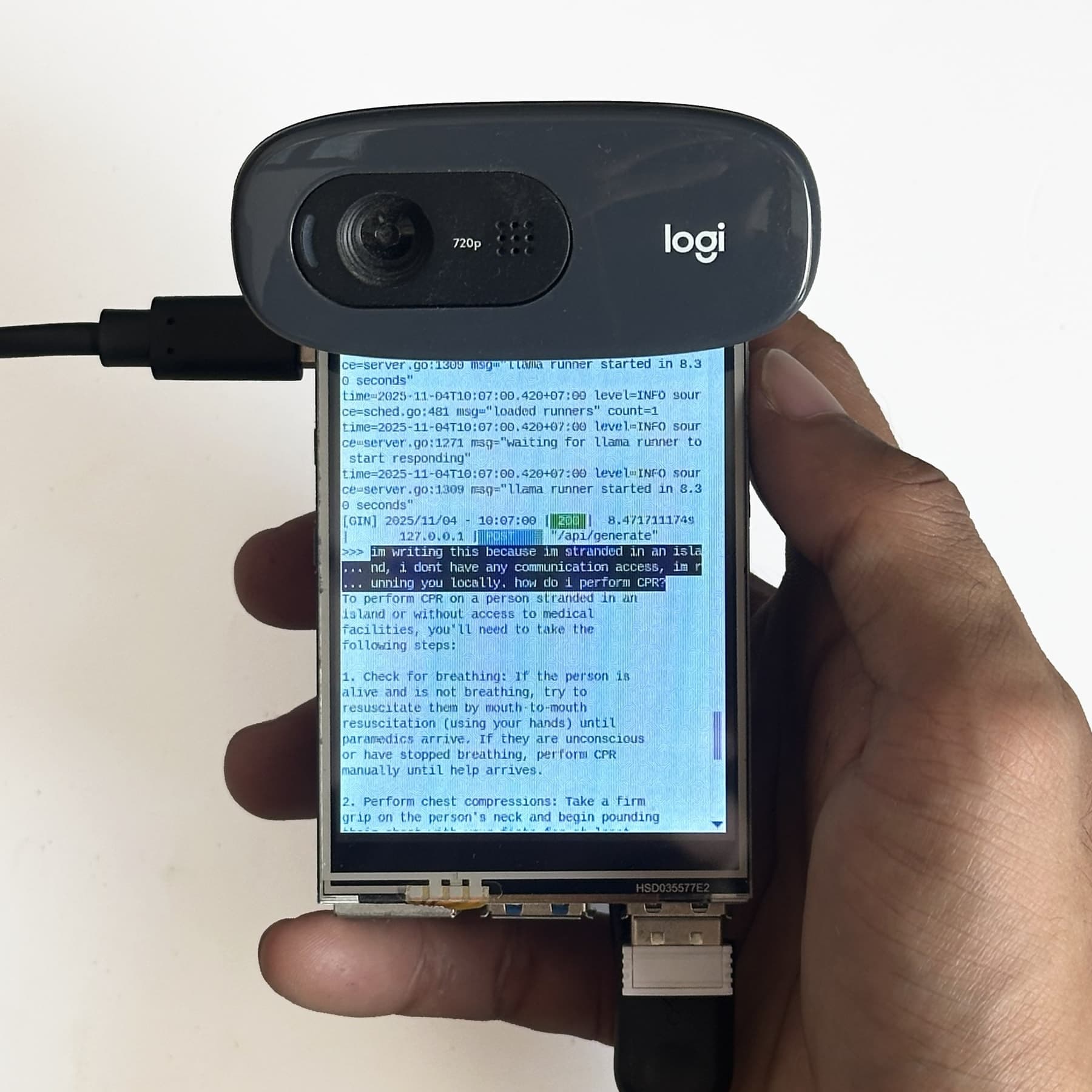
The Raspberry Pi 5 is claimed to run AI efficiently on little electricity. The problem with running AI locally is heat, so I added thermal pads, a heatsink and a fan. A touchscreen LCD and a basic webcam handle output and input.
These photos are from my early days of learning: every part plugs or screws together, no soldering.
Running offline
The device runs a language model locally, TinyLlama or Llama 3.2. A power bank powers it, but power banks run out. So when there is no electricity, the power bank has to be charged by a mechanical crank, turned by hand.
To improve
Power. Running increasingly intelligent AI demands far more energy, which makes a hand crank generator hard to rely on. The workflow is always to charge the power bank first and then turn on the device. The crank can’t power the device directly, because its voltage and supply are inconsistent.
Knowledge. The AI’s survival knowledge could be trained to be more accurate and concise. For now it runs Llama 3.2 (3 billion parameters), because of hardware limits too.